Introduction: Communication Beyond Words
When we talk to people in real life, we rarely rely on words alone. Facial expressions, tone of voice, gestures, pauses-all of this helps others understand what we actually mean.
In fact, most communication is non-verbal. We expect people to get us even when our words are incomplete, because more meaning is usually transferred without the help of words. A raised eyebrow can turn a statement into a question. A pause can add weight to what comes next. A smile can soften criticism into constructive feedback.But none of that exists in digital products.
What Users Don’t See on a Screen
Behind the screen, users don't see our intentions. They don't hear our tone. They don't notice a smile or a small hand gesture that says, “don’t worry, this is safe.” All they have are plain words on a screen. And when everything is perceived only through text, we can't expect users to always understand what we mean.
Every piece of meaning must be deliberately transferred via the words we choose. This is why language in design isn't just about “writing good copy.” It is about replacing the missing human connection within digital-first experiences.
When Things Go Wrong
The importance of words becomes clear the moment something doesn't work as expected. An error appears. A form doesn't submit. A button doesn't do what the user expected.
In real life, someone could immediately explain what happened. They could see the confusion on your face and adjust their explanation. They could reassure you that everything is okay, or apologize for the inconvenience.
In a product, users are left alone. If the message is unclear, technical, or cold, most users don't try to solve it. They close the page, and often never come back. Not because they don't want to continue, but because they don't know how.
The Cost of Poor Language
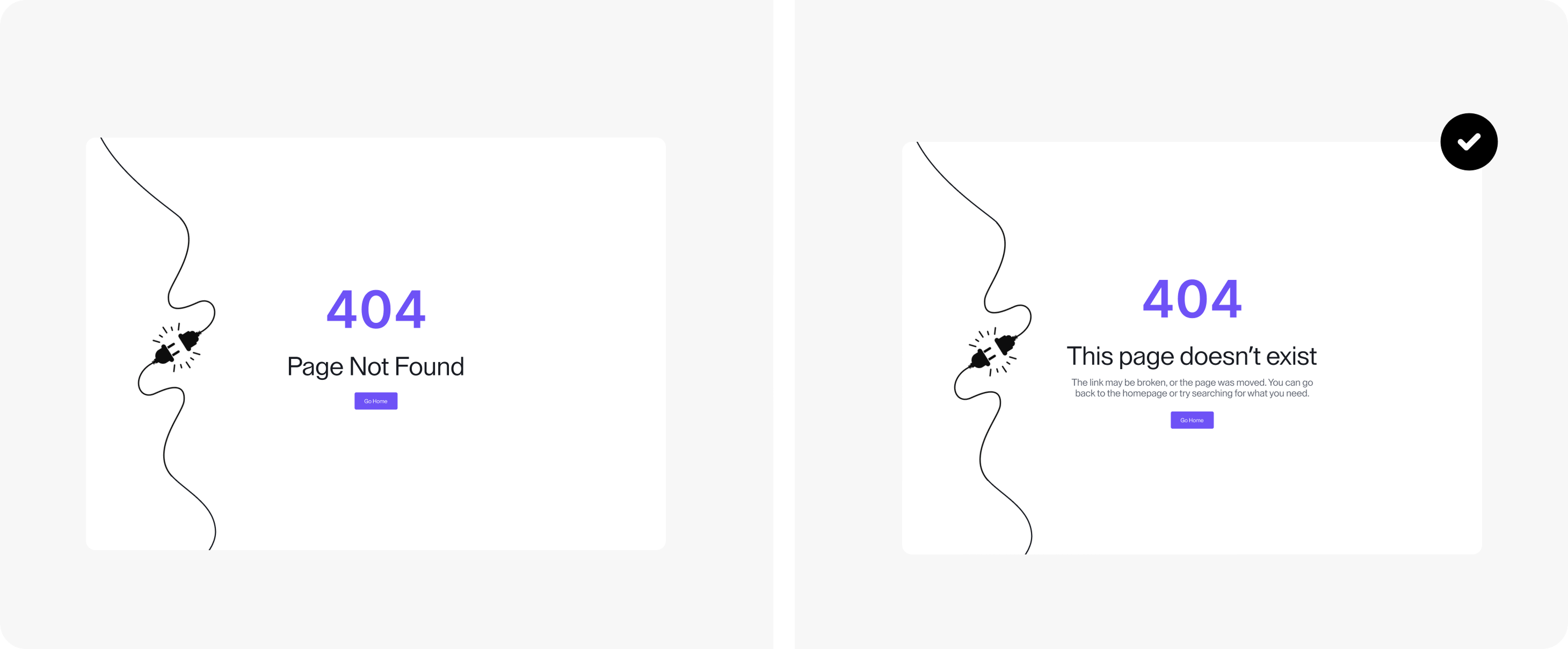
Common scenarios:
“Page not found”
What happened? Did the user make a mistake, or the link is broken? Can the content be saved, or is it lost? Without clear message, the users won’t be able to understand what to do next and simply won’t continue.
“Are you sure you want to delete this?” This appears helpful, but often creates unnecessary anxiety.
What if instead it said, “Delete this cover? You can always add a new one.” Now the user understands the consequence and feels safe.
Each of these examples shows a moment where words really matter. Language can build trust or break it. It can guide users or confuse them. It can keep people engaged, or make them leave.
Good language in design works like good typography. When it’s done well, users don’t notice it. They just feel guided and understood. They move through the product confidently, without stopping to wonder if they’re doing the right thing.
When language doesn’t work, everything feels harder. Users hesitate. They doubt their actions. They leave forms or tasks unfinished because the instructions aren’t clear.
That’s why language is so important. It’s not decoration. It’s a tool. It helps people understand what to do, feel confident, and trust the product.
The Power of Microcopy
Clear, human wording can explain what happened, what didn’t, and what the user can do next. Poor wording creates frustration, self-doubt, and the feeling that the product is broken or even rude. This is why words matter so much more in digital communication than we sometimes admit.
Small pieces of text, a hint under an input, a helper message, an error description-carry a huge responsibility. They replace non-verbal communication.
But good microcopy does more than just explain errors. It sets expectations before something goes wrong. It tells users what will happen if they continue, whether an action is safe, and whether they can undo it later. It reduces anxiety by being specific instead of vague, and by speaking like a human instead of a system.
Microcopy also shows empathy. When something fails, users already feel tension. A message that acknowledges the situation, instead of blaming the user or hiding behind technical language, can completely change how the experience feels. Even a small sentence can make users feel supported, instead of lost.
Another important role of microcopy is consistency.
When a product speaks differently on every screen, users lose confidence. Clear, consistent language helps users build a mental model of how the product works. Over time, they stop thinking about the interface and simply use it.
Microcopy isn’t about being clever or funny. It’s about being useful at the exact moment it’s needed. When it works well, users don’t notice it at all, they just move forward.
And that quiet progress is the real sign of good design.
Language as Part of Design
Over time, I’ve learned that good language often goes unnoticed. Users don’t stop to admire it. They simply move forward without problem. And that’s what really matters.
Bad language, on the other hand, is always noticed. It confuses, annoys, and pushes people away.
Design is not only about how things look. In digital products, language is the main source of communication.
When words are designed with the same care as the interface, the product feels easier to use.
We must remember that behind every screen, there is still a person trying to understand what to do.